
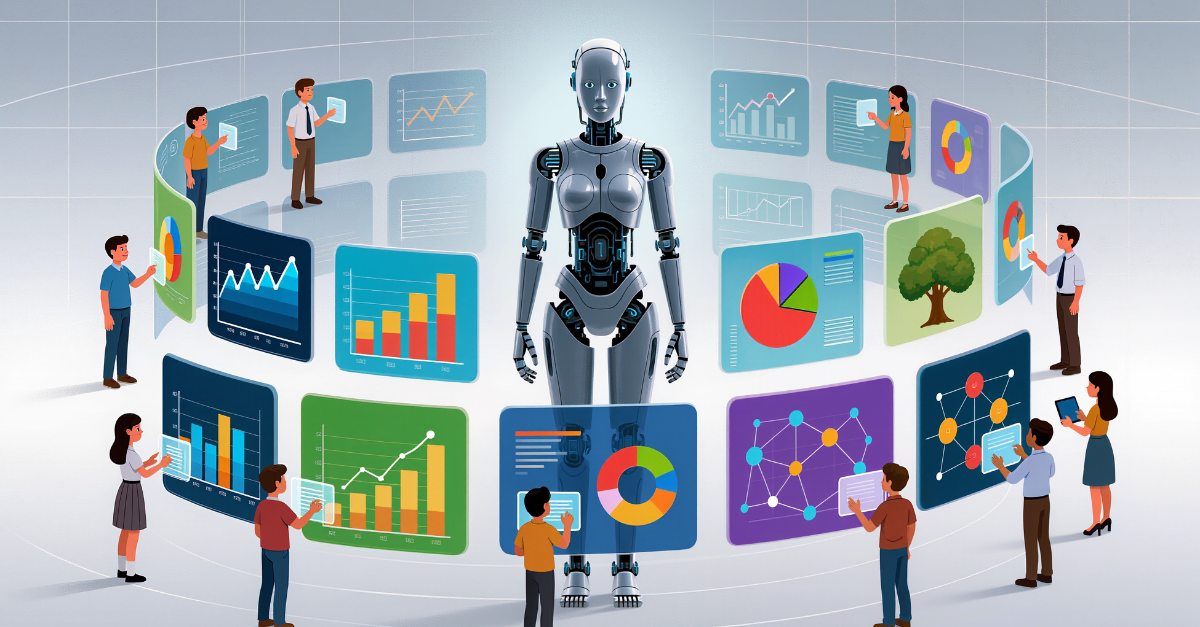
Empowering businesses with unified data, intelligent automation, and real-time insights.
Introduction: How an AI Data Platform Drives Enterprise Transformation
In today’s digital economy, enterprises rely on data-driven decisions to stay competitive. Yet many organizations still operate with siloed systems, fragmented tools, and manual analytics. An AI Data Platform unifies this complexity—connecting data, automating analytics, and enabling real-time intelligence across every layer of the business. This transformation is redefining what it means to be a truly next-generation enterprise.

The Challenge: Why Enterprises Need an AI Data Platform
For decades, enterprises have operated in silos—each department maintaining its own data, tools, and metrics. Legacy databases, manual reporting, and disconnected systems have made it difficult to achieve a single version of truth.
Key challenges include:
-
Disconnected databases and delayed reports
-
Inefficient data processing pipelines
-
Inconsistent governance and security
-
Slow decision-making at the business level
An AI Data Platform solves this by integrating your data lake, analytics tools, and AI systems into one governed ecosystem that scales effortlessly.
From BI to AI Data Platforms: The Evolution of Enterprise Intelligence
Traditional BI tools provided reports after the fact. Modern enterprises need predictive insights and automation in real time. An AI Data Platform bridges this gap by combining the scalability of a Data Lakehouse with the intelligence of machine learning and Agentic AI.
It enables organizations to:
-
Consolidate structured and unstructured data
-
Automate analytics pipelines
-
Deploy AI models directly on governed data
-
Deliver actionable insights instantly
👉 Learn how DataNature 2.0 makes this evolution possible through its unified Lakehouse and AI architecture.

How AI and Data Platforms Drive Enterprise Transformation?
Modern data platforms are built to help enterprises scale intelligently. Here’s how they’re changing the game:
-
Agentic AI – Smart AI agents automate workflows, detect anomalies, and surface insights instantly.
-
Unified Lakehouse – Structured, semi-structured, and streaming data coexist in one secure, governed space.
-
Self-Service BI – Business users can explore and visualize data without relying on IT.
-
Automated Pipelines – ETL/ELT processes move and transform data seamlessly, reducing manual work.
-
Governance & Monitoring – Centralized control ensures compliance, access visibility, and trust in every dataset.
Together, these pillars form the backbone of the intelligent enterprise—agile, data-driven, and continuously learning. Read our insights on Agentic AI for Enterprises.

Industry Impact: Real-World Applications of AI Data Platforms
The rise of AI Data Platforms is revolutionizing every industry:
-
Banking & Finance: Fraud detection, credit risk modeling, and customer 360° views.
-
Telecom: Network optimization, churn prediction, and dynamic customer segmentation.
-
Healthcare: Predictive diagnosis and patient-centric analytics.
-
Manufacturing: IoT-driven predictive maintenance and supply chain visibility.
-
Retail: Personalized experiences and real-time demand forecasting.
According to McKinsey, companies using unified AI data platforms outperform peers in innovation and profitability.
For a deeper look at enterprise automation, read our guide on Agentic AI for Business.
Building a Next-Gen Enterprise with the DataNature AI Data Platform
At Dlytica, we built DataNature 2.0, an AI Data Platform designed for real-world enterprises.
It unifies your Lakehouse, ETL/ELT pipelines, BI tools, and AI automation—while maintaining governance, sovereignty, and scalability.
With DataNature 2.0, organizations can:
-
Deploy AI models securely on governed data
-
Enable cross-department analytics collaboration
-
Reduce time-to-insight with automated workflows
-
Ensure compliance through centralized policies
It’s the foundation for data-driven innovation and sustainable growth.

Best Practices for Enterprise Adoption
-
Start with a clear data strategy aligned with business goals.
-
Prioritize governance—security and trust must come first.
-
Integrate incrementally to ensure minimal disruption.
-
Build cross-functional data teams combining IT, AI, and business expertise.
-
Measure ROI through time-to-insight, automation impact, and decision accuracy.
Conclusion: The Future Is Intelligent and Unified
AI and data platforms are no longer optional—they’re the strategic core of modern enterprises. By unifying data, enabling intelligence, and ensuring governance, organizations can unlock new possibilities in innovation and growth.
If your business is ready to evolve into a next-generation enterprise, now is the time to act.
Schedule a demo with DLytica today!